How to play
Get 3 rings in a row to rest on your colour, or to read your secret sequence. You do it by outguessing what the other player will put in their hand.
The board
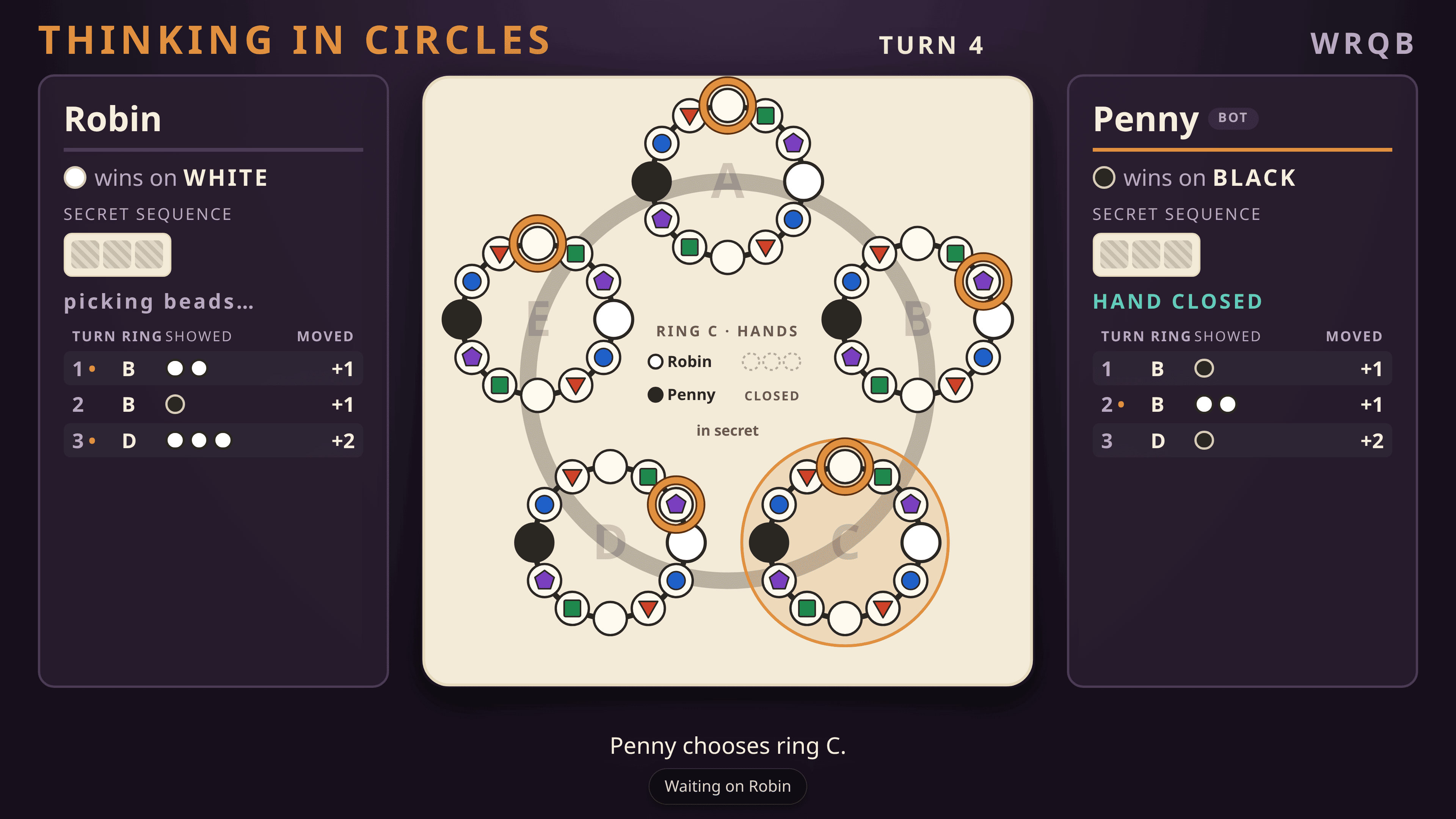
- 5 rings sit on one big grey loop. Each ring has 12 spaces and one copper token. Every token starts on the checkered space at the top of its ring.
- Round each ring: two of each shape, one white space, one black space and two checkered neutral spaces.
- Rings next to each other on the loop are neighbours. Three in a row means three neighbours along the loop.
circle triangle square pentagonwhiteblack
Before play
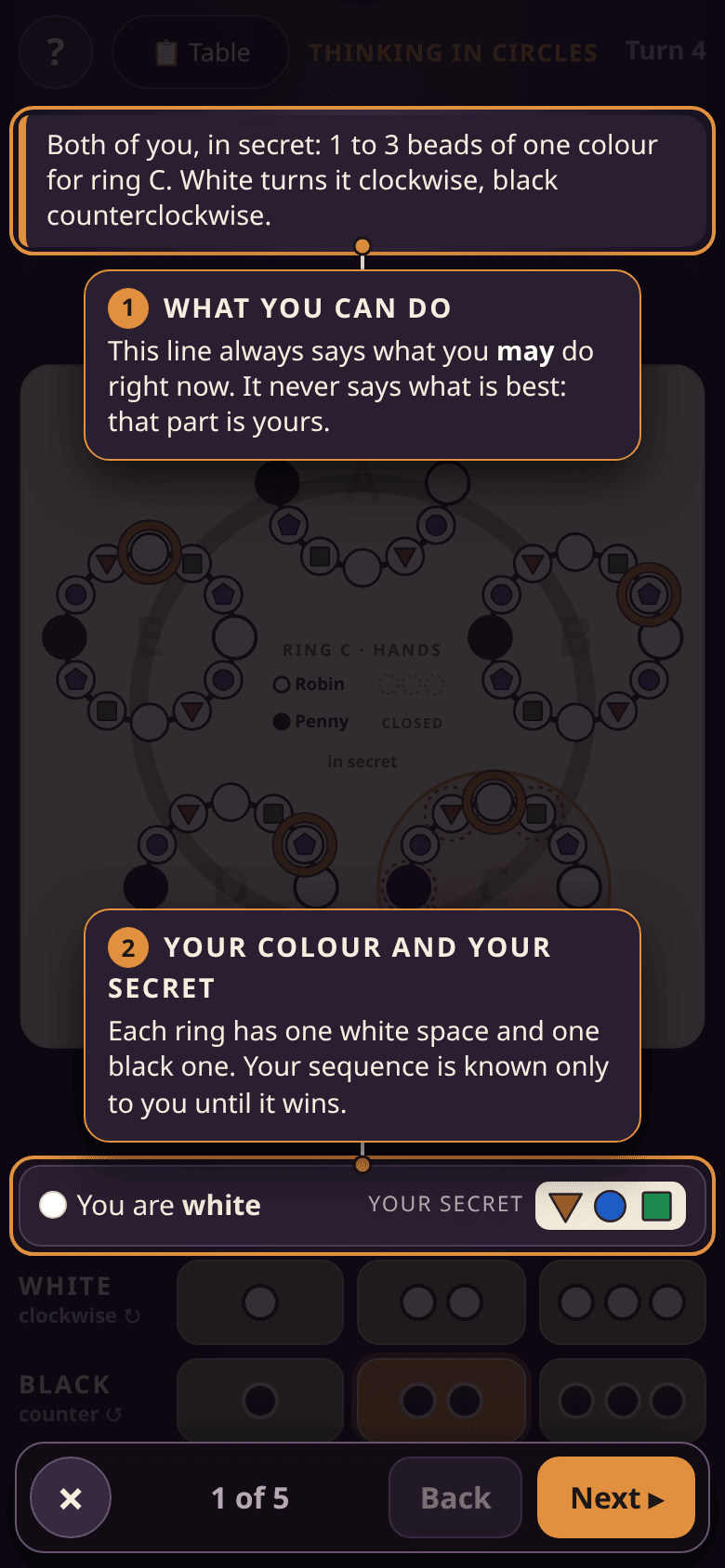
- Each of you writes a secret sequence of 3 shapes, any of the 4, repeats allowed. It stays on your phone.
- A coin toss gives one of you white and the other black, and says who goes first.
A turn
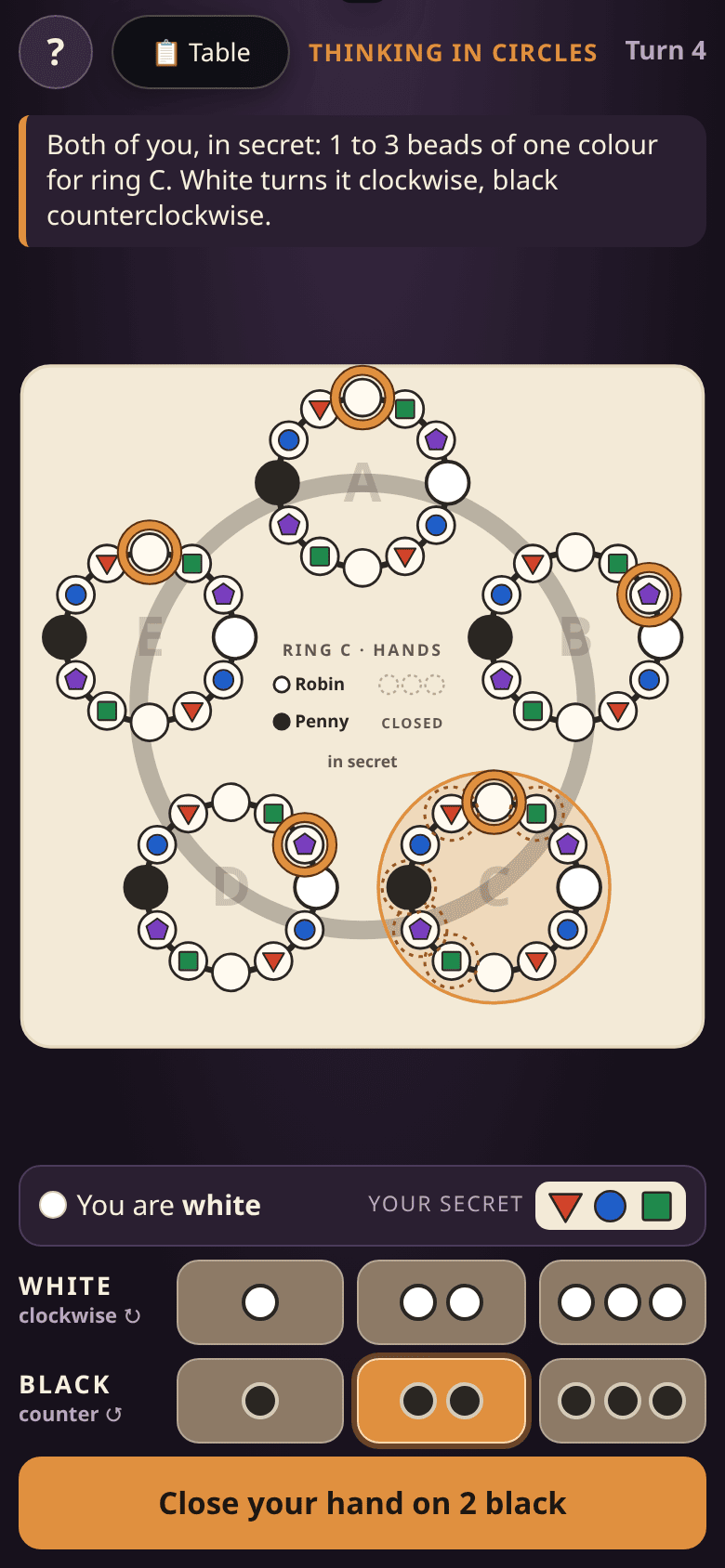
- The player whose turn it is chooses a ring. Only that ring's token will move.
- Then both players secretly take one to 3 beads of one colour: white or black, whichever you like, whatever colour you are playing.
- Both hands open together. Each white bead is +1 and each black bead is -1. Add them up: anything from -6 to +6.
- The token moves that many spaces: clockwise for a plus, counterclockwise for a minus. On zero it stays put.
- Then it is the other player's turn to choose a ring.
Winning
- Your colour: three neighbouring rings whose tokens all rest on your colour.
- Your sequence: three neighbouring rings whose tokens rest on your three shapes, in order. The order matters, but it may be read in either direction along the loop.
- It does not matter whose turn it is. If one move wins for both of you, the win is shared.
Variants
All four are on Jonathan's rules page, and all four are switches in the lobby.
- Spin Cycle: a faster game. Each player writes two or three secret sequences instead of one.
- UnCloned: a sequence may not have two identical shapes next to each other.
- Wild Cards: a token on your own colour counts as any shape in your sequence.
- Lockdown: each player starts with 1 Blocker token. After the other player chooses a ring, you may spend a Blocker to make them choose a different one. You take a new Blocker when a token lands on a checkered space on your own turn (staying put on one counts).
Good to know
- You may change a closed hand, or rewrite your sequence, until the other player has finished theirs.
- Bots fill an empty seat and play by the same rules through the same door: a bot sees what a player sees, and not your sequence.
- If your phone sleeps, your seat waits. A bot covers for you only after five minutes, with a clock on screen first, and one tap takes the seat back.
Thinking In Circles is by Jonathan Leistiko (Invisible City Productions, 2004), who thanks Ben for playtesting it while they waited out a rainstorm. The rules call the five big circles "circles"; this page calls them rings so that "circle" can mean the shape. The original rules and the printable board: invisible-city.com/content/thinking-circles.